
C2C vs W2 vs 1099: What IT Contractors in the USA Need to Know (2026)
By [Author shanker] Last updated: November 14, 2026
This article is general information for job seekers. It is not tax, legal or immigration advice. Rules change and individual situations differ, so confirm important decisions with a qualified professional.
The short answer
W2: you are an employee of the staffing firm or employer. They withhold your taxes and pay the employer share of Social Security and Medicare.
C2C (corp-to-corp): your own company, usually an LLC or corporation, signs a contract with the staffing firm or client. You are a business, so you handle your own taxes, insurance and benefits.
1099: you work as an individual independent contractor and receive a Form 1099 for your income instead of a W-2. You are not an employee and not a separate company.
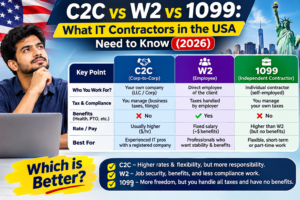
C2C vs W2 vs 1099
C2C and 1099 usually come with a higher hourly rate than W2, but you take on taxes, benefits and risk yourself. For people on a work visa such as OPT, STEM OPT or H-1B, the choice is often not yours: these statuses generally require a W2 employer.
C2C vs W2 vs 1099 at a glance
| W2 | C2C | 1099 | |
|---|---|---|---|
| Who you work for | The staffing firm or employer is your employer | Your own company contracts with the staffing firm | You contract as an individual |
| How you are paid | Paycheck with taxes withheld | Your company invoices and is paid | You invoice and are paid, with a 1099-NEC at year end |
| Payroll taxes | Employer pays half of Social Security and Medicare (7.65%) | Paid through your business | You pay the full 15.3% self-employment tax |
| Benefits | Often available (health insurance, sometimes 401(k)) | You arrange your own | You arrange your own |
| Paid time off and bench time | Sometimes | Usually none | None |
| Typical hourly rate | Lowest of the three | Higher | Higher |
| Setup needed | None | Business entity, bank account, insurance, an accountant | Little setup, but you pay estimated taxes |
| Legal and tax risk | Lowest | Medium | Highest (worker classification) |
| Visa-friendly | Yes, with caveats | Generally no | Generally no |
| Best for | Visa holders and people who want stability | Experienced contractors with their own business | Short independent projects |
W2 contracts explained
On a W2 contract, a staffing firm hires you as its employee and places you with a client. You get a paycheck with income tax and payroll taxes withheld, and a Form W-2 each January.
Pros
- No business setup, no quarterly tax payments.
- Possible benefits: health insurance, sometimes retirement matching and paid leave.
- Required for most work visas.
- Lowest tax and paperwork burden.
Cons
- Lower hourly rate than C2C or 1099, because the staffing firm covers payroll taxes and benefits.
- Fewer tax deductions.
- Contract can end with little notice, as with the other types.
Watch for: the difference between W2 contract and W2 full time. A W2 contract often has no paid time off or pay during gaps between assignments, even though you are an employee.
C2C (corp-to-corp) explained
On C2C, your own company, often an LLC or an S corporation, signs the contract with the staffing firm. The client pays your company, and your company pays you.
What you need
- A registered business entity in your state.
- A business bank account and an EIN.
- Business insurance if the contract requires it (some clients ask for general liability or professional liability).
- An accountant who understands contractor taxes.
Pros
- Usually the highest hourly rate.
- More tax deductions through your business.
- Flexibility: your company can work with several clients.
Cons
- You pay for your own health insurance, retirement savings, and time off.
- Setup and ongoing costs: formation fees, state filings, accounting.
- You carry the risk if a contract ends early or a client pays late.
- Many large clients and staffing firms do not accept C2C, so it limits the roles open to you.
Good to know: how payments are reported depends on how your company is taxed. Payments to an LLC taxed as a sole proprietorship are typically reported on a 1099, while payments to a corporation often are not. Ask your accountant how this applies to you.
1099 independent contractor explained
On 1099, you contract with the client as an individual. The client pays you without withholding any tax and sends you a Form 1099-NEC if they pay you $600 or more in a year.
Pros
- Simple to start, with no company formation required.
- Flexibility over how you work.
Cons
- You pay the full self-employment tax and make estimated tax payments quarterly.
- No benefits, and no legal separation between you and the business.
- The highest risk of being misclassified (see below).
In practice, many staffing firms prefer C2C over 1099, because a company contract is cleaner for them than a contract with an individual.
How taxes differ
Employees (W2). You and your employer each pay 7.65% in Social Security and Medicare taxes. The employer’s share does not come out of your paycheck.
Contractors (C2C or 1099). You pay both halves through the self-employment tax, which is 15.3%: 12.4% for Social Security and 2.9% for Medicare. The tax applies to 92.35% of your net earnings, and you can deduct half of it from your taxable income. The Social Security part stops at an annual earnings limit, which is $184,500 for 2026.
A simple illustration (federal payroll tax only). On $100,000 of net earnings, a W2 employee pays $7,650 in Social Security and Medicare tax. A self-employed contractor pays roughly $14,130 in self-employment tax. That is about $6,500 more before deductions, which is one reason contractors need a higher rate. Income tax, state taxes and deductions come on top, so this is only a rough comparison.
Worker classification: why the label on the contract is not enough
Calling someone a contractor does not make them one. The IRS looks at three categories of evidence to decide whether a worker is an employee or an independent contractor:
- Behavioral control: does the company direct how, when and where you do the work?
- Financial control: who provides the tools, covers expenses and bears profit or loss?
- Relationship: is it ongoing, with benefits, and is your work a core part of the company’s business?
No single factor decides it. The US Department of Labor uses a separate test for wage and hour law, and guidance on it has changed in recent years, so check the current rules. If a client treats you like an employee, with set hours and direct supervision, but pays you on a 1099, ask an accountant or attorney whether the arrangement is sound.
How to compare a W2 rate with a C2C or 1099 rate
A higher hourly rate does not automatically mean higher take-home pay. When you compare offers, work out what the higher rate has to cover.
What C2C and 1099 rates must cover
- The extra payroll tax (about 7.65 percentage points on earnings, before deductions).
- Health insurance, which a W2 employer may subsidize.
- Time off and unpaid gaps between contracts.
- Business costs: accountant, insurance, entity fees, software, equipment.
- Retirement saving you would otherwise get as a match.
A rough rule of thumb. One source suggests that a W2 worker earning $100,000 would need roughly $130,000 as a 1099 contractor to end up with a similar take-home. The right figure for you depends on your state, health coverage, and how steady the work is, so treat that number as a starting point only.
A simple way to compare
- Estimate your yearly pay on each offer (hourly rate × expected paid hours).
- Subtract the extra costs above for the C2C or 1099 option.
- Compare what is left, and note how much risk each option carries.
Visas: OPT, STEM OPT and H-1B
If you work on a visa, the type of contract matters a great deal. Rules change and each case is different, so confirm with your school’s international office (DSO), your sponsoring employer, or an immigration attorney before accepting a contract. The points below are general summaries from published guidance.
- H-1B: an H-1B is tied to the employer that filed your petition, and the relationship must be a genuine employer-employee one. Independent contracting or side work for other companies is generally not allowed unless a separate petition covers it. This makes C2C and 1099 arrangements generally unavailable on H-1B.
- STEM OPT (the 24-month extension): the program requires an employer-employee relationship and a training plan (Form I-983) signed by the employer. That generally rules out self-employment, 1099 and standard C2C work. Staffing firms can employ STEM OPT students on W2 if they meet the program’s training and employer requirements, but USCIS guidance on this has changed over time, so check the current rules.
- Initial OPT (the first 12 months): published guidance describes more flexibility here, including self-employment and contract work related to your degree, with conditions and reporting duties. Get written confirmation from your DSO before accepting a contract.
- Green card holders and citizens: all three arrangements are generally available.
Official information: USCIS and the Study in the States site from the Department of Homeland Security.
Red flags in contract offers
- A rate far below the market for the role, or no rate stated at all.
- No named end client, or a client name that changes.
- Requests to pay money, buy equipment, or pay for training before you start.
- No written agreement, or payment terms that are vague (for example, “paid when the client pays” with no date limit).
- Pressure to switch between W2, C2C and 1099 to suit the recruiter.
- A recruiter who avoids giving a company name or website.
Verify the staffing firm’s website, address and reviews, and get the terms in writing before you sign.
Which one should you choose?
W2 is usually the better fit if you:
- are on OPT, STEM OPT or H-1B, or are not sure about your visa rules
- want benefits and simple paperwork
- are new to contracting
C2C may suit you if you:
- are a US citizen or green card holder with several years of experience
- are comfortable running a small business
- can cover your own insurance and gaps between contracts
1099 may suit you if you:
- have short, independent projects and do not need a company structure
- understand estimated tax payments and the misclassification risk
If you are unsure, talk to an accountant before you sign a C2C or 1099 contract, since the tax and legal effects are hard to undo later.
Frequently asked questions
Is C2C better than W2? Not always. C2C usually pays more per hour, but you carry the taxes, insurance, time off and business risk. W2 pays less per hour but is simpler and often includes benefits. Compare total take-home pay and risk, not just the hourly rate.
Can I do C2C on OPT or H-1B? On H-1B, generally no, because the visa requires an employer-employee relationship with your sponsoring employer. On STEM OPT, generally no for the same reason. On initial OPT, published guidance describes more flexibility. Confirm with your DSO or an immigration attorney in writing before you accept.
Do I need an LLC for C2C? C2C means your own company contracts with the client, so you need a registered business entity. Many contractors use an LLC or an S corporation. An accountant can advise which structure fits your situation and state.
What is a good C2C rate? It depends on your skills, experience, location and the client. Rather than a fixed number, convert any W2 offer into a C2C equivalent by adding the extra tax, benefits, time off and business costs, then compare take-home pay.
What is the difference between C2C and 1099? On C2C your company contracts with the client. On 1099 you contract as an individual. Many staffing firms prefer C2C because dealing with a company is simpler than dealing with an individual.
Can a client reclassify me as an employee? Yes. Agencies look at how the relationship works in practice, not just the contract label. If you are treated like an employee, the arrangement can be challenged.
Related jobs and guides
- Browse all current openings on our jobs page.
- See an example C2C and contract role: AI Cloud Engineer, Austin, TX (Contract).
- Read our guide: AI and Machine Learning Jobs in the USA 2026: Roles, Skills and Salary.
- [Add a link to your Databricks data engineer post here.]
Sources
- IRS, Independent Contractor (Self-Employed) or Employee?
- IRS, Topic 554: Self-employment tax
- US Department of Labor, Wage and Hour Division: misclassification
- USCIS, official US immigration information
- Study in the States, US Department of Homeland Security
- SelfEmployed.com, Employee vs Self-Employed: Key Differences Explained (2026 figures)
- SDO CPA, W-2 vs 1099 in 2026
- Startup Owl, Contractor vs Employee
- f1jobs.io, Contract / C2C vs Full-Time Employment for Visa Sponsorship
- Prodigy Finance, Contract work while on F-1 and H-1B visas
Tax rates, wage limits and immigration rules change. Check the original source for the latest figures before you make a decision.

3 thoughts on “C2C vs W2 vs 1099: What IT Contractors in the USA Need to Know (2026)”