
The Ultimate Microsoft Interview Guide 2026: From Process Breakdown to Securing the Offer
Ultimate Microsoft Interview Guide 2026 Securing a role at Microsoft is a career-defining milestone. As of 2026, Microsoft stands at the pinnacle of the “AI Era,” driven by its massive investment in OpenAI, the global scale of Azure, and the ubiquitous nature of Microsoft 365. However, getting hired requires more than just knowing how to code; Microsoft Software Engineer Interview Process it requires a specific alignment with the company’s evolved “Growth Mindset” culture Microsoft Interview Questions 2026
In this guide, we break down the entire 2026 interview pipeline, provide high-frequency technical questions with solutions, and reveal the behavioral secrets to passing the “As Appropriate” (AA) round Ultimate Microsoft Interview Guide 2026
1. The 2026 Microsoft Interview Process
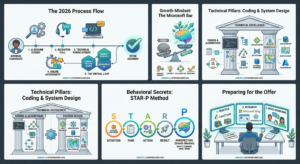
Ultimate Microsoft Interview Guide 2026 The interview process at Microsoft has transitioned into a highly streamlined, virtual-first experience. While specific teams (like Xbox or Surface) may have slight variations, the core SDE (Software Development Engineer) track follows this 5-step journey.
1.1 The AI-Powered Resume Screen
In 2026, Microsoft’s initial screening is heavily augmented by AI. To pass, your resume must be “impact-centric.” Recruiters no longer look for a list of responsibilities; they look for results Ultimate Microsoft Interview Guide 2026
-
The Formula: “Reduced latency by 30% [Result] by implementing a Redis caching layer [Action] for a distributed messaging service [Context].” Microsoft SDE Interview Guide
-
Keywords: Ensure you include terms like Cloud-native, Generative AI, Scalability, Distributed Systems, and Growth Mindset.
1.2 The Recruiter Screen (30 Minutes)
This is a “fit” check. The recruiter wants to ensure you are interested in Microsoft for the right reasons.
-
Key Question: “Why Microsoft over Google or Meta?”
-
Winning Strategy: Connect your personal goals to Microsoft’s mission: “To empower every person and every organization on the planet to achieve more.” Mention a specific product (e.g., Azure Quantum or Copilot) that genuinely excites you.
1.3 The Technical Phone Screen (60 Minutes)
Ultimate Microsoft Interview Guide 2026 Conducted via Microsoft Teams, this round involves a peer engineer. You will use a collaborative coding environment (like CoderPad or a shared VS Code session).
-
Structure: 10 mins introduction, 45 mins coding, 5 mins Q&A.
-
Difficulty: Usually a “LeetCode Medium” problem focusing on Strings, Arrays, or Linked Lists.
Capital One Remote Jobs 2026
1.4 The Online Assessment (OA)
For university grads and some SDE I roles, Microsoft utilizes a proctored online test (HackerRank/Codility). You typically face 2–3 algorithmic challenges in 90 minutes Microsoft Behavioral Interview Questions
1.5 The Virtual Loop (The “Onsite”)
The final stage consists of 4 to 5 back-to-back interviews.
-
Coding Rounds (2-3): Deep dives into Algorithms and Data Structures.
-
System Design (1-2): Mandatory for SDE II (Level 61+) and above. You will design large-scale services like “Azure Blob Storage” or “A Global Notification System.”
-
The “As Appropriate” (AA) Interview: This is the “Bar Raiser” round. You will meet with a senior leader (Principal or Partner level) who focuses on your behavioral traits and high-level problem-solving. They have the final “Hire/No Hire” authority Microsoft Coding Interview Preparation
2. Cultural Pillar: The Growth Mindset
Microsoft’s culture underwent a massive shift under CEO Satya Nadella. They moved from a “Know-it-all” culture to a “Learn-it-all” culture. In 2026, this is the #1 trait interviewers look for Microsoft System Design Interview 2026
How to Demonstrate a Growth Mindset:
-
Embrace Feedback: If an interviewer corrects your code, don’t get defensive. Say, “That’s a great point, I hadn’t considered that edge case. Let me incorporate that into the logic.”
-
Be Curious: Ask deep questions about the team’s technical challenges.
-
Talk About Failure: Have a story ready where you failed, took ownership, and implemented a process to ensure it never happened again Top Resume Making Tips for 2026
3. High-Frequency Technical Questions & Solutions
To succeed at Microsoft, you must master specific patterns. Below are three of the most common questions reported by candidates in 2026.
3.1 Coding: Implement an LRU Cache (Medium/Hard)
This is perhaps the most famous Microsoft question. It tests your ability to manage memory and combine data structures for optimal performance.
The Goal: Design a cache that supports get and put operations in $O(1)$ time. When the cache reaches capacity, it should invalidate the least recently used item Microsoft Interview Experience 2026
The Solution: Use a Hash Map (for $O(1)$ access) paired with a Doubly Linked List (to maintain order).
class Node:
    def __init__(self, key, val):
        self.key, self.val = key, val
        self.prev = self.next = None

class LRUCache:
    def __init__(self, capacity: int):
        self.cap = capacity
        self.cache = {} # Map key to nodes
        self.head, self.tail = Node(0, 0), Node(0, 0)
        self.head.next, self.tail.prev = self.tail, self.head

    def _remove(self, node):
        p, n = node.prev, node.next
        p.next, n.prev = n, p

    def _add(self, node):
        p, n = self.head, self.head.next
        p.next = node
        node.prev, node.next = p, n
        n.prev = node

    def get(self, key: int) -> int:
        if key in self.cache:
            self._remove(self.cache[key])
            self._add(self.cache[key])
            return self.cache[key].val
        return -1

    def put(self, key: int, value: int) -> None:
        if key in self.cache:
            self._remove(self.cache[key])
        self.cache[key] = Node(key, value)
        self._add(self.cache[key])
        if len(self.cache) > self.cap:
            lru = self.tail.prev
            self._remove(lru)
            del self.cache[lru.key]
3.2 Algorithms: Merge K Sorted Lists (Hard)
How to get a job at Microsoft 2026 Microsoft loves linked lists because they require careful pointer management—a skill essential for low-level systems work.
The Strategy: Use a Min-Heap.
-
Push the head of every list into the heap.
-
Pop the smallest element and add it to your result list.
-
If the popped node has a “next” node, push that into the heap.
-
Repeat until the heap is empty.
Complexity: $O(N \log k)$ time, where $k$ is the number of lists and $N$ is the total number of nodes.
3.3 System Design: Design a Web Crawler for Bing
This tests your understanding of distributed systems, concurrency, and data persistence.
Key Components to Discuss:
-
URL Frontier: Use a priority queue to manage which URLs to crawl next (based on “Freshness” and “Authority”).
-
HTML Fetcher: Discuss handling robots.txt and “Politeness” (not DDOSing servers).
-
Content Deduplication: Use Fingerprinting (MD5 or SHA) to ensure you aren’t storing the same page twice.
-
Storage: Use a NoSQL database (like Azure Cosmos DB) to store the massive amounts of unstructured data
Google Software Engineer Interview Guide (2026 Edition)
4. Behavioral Questions: The STAR-P Method
Don’t just use the STAR method (Situation, Task, Action, Result). For Microsoft, use STAR-P. The “P” stands for Perspective.
Example Question: “Tell me about a time you disagreed with your manager.”
-
Situation: We were launching a new API.
-
Task: My manager wanted to release it without full integration tests to meet a deadline.
-
Action: I gathered data on previous bugs found during integration tests and presented a “Phased Rollout” plan that allowed us to meet the deadline while testing in production for 5% of users.
-
Result: The API launched on time, we caught 2 critical bugs in the 5% tier, and the manager thanked me for the data-driven approach.
-
Perspective (The Growth Mindset): “I learned that conflict is healthy when backed by data, and that as an engineer, my job is to propose solutions, not just point out problems.”
5. Understanding Microsoft Levels & Compensation
Knowing where you fit is crucial for negotiation. Microsoft uses a numerical leveling system.
| Level | Title | Typical Experience |
| 59-60 | SDE (Junior) | 0–2 years (New Grads) |
| 61-62 | SDE II (Mid-Level) | 3–5 years |
| 63-64 | Senior SDE | 5–8 years |
| 65-67 | Principal SDE | 10+ years |
Compensation Structure:
-
Base Salary: Market-competitive.
-
Annual Bonus: Performance-based (usually 0–20%).
-
Stock (RSUs): The “Gold Mine.” Microsoft grants stock that vests over 4 years. In 2026, stock refreshers are a major part of the total compensation package Ultimate Microsoft Interview Guide 2026
6. Microsoft Interview FAQ (2026)
Q: Do I need to know Azure to get hired?
A: No. While knowing Azure is a plus, Microsoft hires for core engineering principles. They believe a good engineer can learn any stack Ultimate Microsoft Interview Guide 2026
Q: Is the “Whiteboard” interview still a thing?
A: Virtually, yes. You will use digital tools like Microsoft Whiteboard or an integrated IDE. Focus on writing clean, readable code even without an auto-compiler.
Q: How do I handle the “System Design” round if I’ve only worked on small apps?
A: Study the “Designing Data-Intensive Applications” book. Focus on concepts like Load Balancing, Sharding, Microservices, and Caching. Practice drawing the flow of data from a user’s phone to a database.
Q: What is the most common reason people fail the Microsoft interview?
A: Lack of communication. Microsoft values “Think-out-loud” candidates. If you sit in silence for 10 minutes and then produce perfect code, you might still fail because they don’t know how you solve problems with a team.
Q: Does Microsoft allow “Remote” work in 2026?
A: Microsoft generally follows a “Hybrid” model. Most teams require 2-3 days in the office, though some roles are designated as “Remote-Eligible.”
7. Final Preparation Checklist
-
[ ] LeetCode: Solve the top 50 “Microsoft” tagged questions.
-
[ ] System Design: Watch videos on how “Azure Load Balancer” and “Cosmos DB” work.
-
[ ] Behavioral: Prepare 5 STAR-P stories covering Conflict, Failure, Leadership, and Innovation.
-
[ ] Environment: Ensure your Teams setup, lighting, and internet connection are flawless.
-
[ ] Questions for them: Prepare 3 deep technical questions for your interviewers (e.g., “How is your team handling the transition to LLM-orchestrated workflows?”).
Conclusion
The Microsoft interview is a marathon, not a sprint. By focusing on the Growth Mindset, mastering Distributed Systems, and polishing your STAR-P stories, you can navigate the 2026 interview loop with confidence.
Good luck—your future at Redmond awaits!

2 thoughts on “The Ultimate Microsoft Interview Guide 2026”