
Spring Boot vs. Node.js for Microservices in 2026: Which Stack Wins the High-Scale War?
Spring Boot vs. Node.js for Microservices in 2026
Spring Boot vs. Node.js for Microservices Microservices have grown past buzzwords; they sit at the core architecture for scale when dealing with cloud apps. Firms are essentially shattering the monolith into tiny, separate, throwaway pieces that can be scaled fast and adjusted on the go from a fintech platform to a SaaS product making use of AI Spring Boot vs. Node.js for Microservices
Spring Boot vs. Node.js for Microservices Spring Boot and Node.js are the first two words that come to mind when someone asks about building microservices. They have since then grown up, amassed considerable fan bases, but their expertise lies in different domains. Here is a rather simple, actual-world comparison of the two for if you have to pick one in 2026 Spring Boot vs. Node.js for Microservices
Spring Boot by Design Enterprise-Grade Spring Boot vs. Node.js for Microservices
Spring Boot belongs to the Java world and adheres to a structured, opinionated way. It removes boilerplate configuration letting you work on business logic yet keeps architectural discipline very well Spring Boot vs. Node.js for Microservices
By 2026, Spring Boot constantly bakes in:
* Cloud-native tools
* Enterprise security standards
* Large-scale transactional systems
Expect to see Spring Boot humming along inside banks, insurance firms, healthcare outfits plus big B2B platforms
Node.js uses JavaScript (and TypeScript) so it draws teams that want to go fast, be nimble, and do quick iterations.
Node.js microservices work great in: Real-time apps. High input/output operations APIs. The Node.js world is huge, very lively, and driven by people
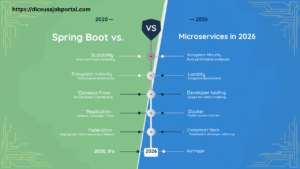
How They Act In Real Microservices Cases Java Interview Guide
Spring Boot gets help from the steady tuning plus boosts typical for JVMs. By 2026, better JVM speed along with garbage pickup and even quicker startups (due to native compiling) can be surely awaited Spring Boot vs. Node.js for Microservices
Strengths
Spring Boot is great in workloads that are CPU-bound, with consistency and reliability as well as predictability in performance under high enterprise traffic Spring Boot vs. Node.js for Microservices
Trade-offs
More memory consumption per service than Node.js and the cold start is slower (but better than in previous years).
Node.js Performance
Node.js uses an event-driven non-blocking model and hence can support thousands of requests at the same time.
Advantages
• Best for I/O bound microservices • Faster initialization times • Lower memory usage

Trade-offs
• Not great for CPU-bound tasks if not offloaded
• Has to be very carefully written so that it does not block the event loop
Spring Boot is more about long-term care than short-term medication. Once a single service is set up, teams get safe scalability of development across several services.
Recommended for:
– Java-friendly programmers
– Teams on tight design patterns
– Projects that are long-term enterprises
Learning curve: Moderate to steep, especially for beginners. Spring Boot vs. Node.js for Microservices
Node.js glows in developer velocity. Teams working on the front-end and back-end use JavaScript or TypeScript, often sharing code.
Best for:
– Full-stack developer
– Startups, agile teams
– MVPs needing rapid release
Learning curve: Easier for web devs.
2026 Scalability and Cloud-Native Readiness Spring Boot vs. Node.js for Microservices
Both are the top picks for Kubernetes microservices but offer very different tastes of scaling.
Spring Boot fits complex distributed systems and mostly is used in big Kubernetes sets.
Node.js Scaling
Node.js shines in side-by-side scaling, fitting well at API gateways as edge services. It does great work with serverless builds and boxed answers.
By 2026, many firms use Node.js for light outside help while leaning on Spring Boot for the main business logic.
Spring Boot has security at the core. Security features encompass authentication, authorization, OAuth, and other enterprise standards as well as strong transaction management.
Node.js
By 2026, security in Node.js will have been greatly enhanced but still largely based on developer discipline and third-party libraries. Regular dependency updates increase the security of the application if managed properly but require proactive maintenance.
Spring
High demand in big firms used more for top and design jobs gives more steadiness and long project chances.
Node.js Jobs Microservices Resume Guide
Big need in new firms and product-led groups best for full-stack and API-linked jobs. Faster start for new coders.
From a job view, Spring Boot gives depth while Node.js offers width and speed.
Choose Spring Boot if you seek enterprise microservices with a focus on solid security and transactional consistency, complex business logic, or long-term scalability and maintenance. Node.js, on the other hand, offers incredible speed and flexibility for modern, fast-paced development. Top teams don’t settle for just one choice; they select the right tool for each microservice Spring Boot vs. Node.js for Microservices
Cannot discuss pay or hybrids. What else do you want?
